Vulnerability states
The impact report shows a state for every entry, such as open or resolved, but the Vulnlog file has no field for it.
Vulnlog works out the state each time it reads the file, from the verdict, the disposition, and the resolution you recorded.
Why the state isn’t a field
A state you write by hand can disagree with the rest of the entry.
An entry could say resolved without naming the release that fixes it, or stay open after the fix shipped.
Because Vulnlog derives the state, it always matches what the entry says.
To change the state, you change the facts behind it: you record a verdict, a disposition, or a resolution.
How the facts lead to a state
Vulnlog checks the facts in a fixed order, and the first answer that leads to a state decides it:
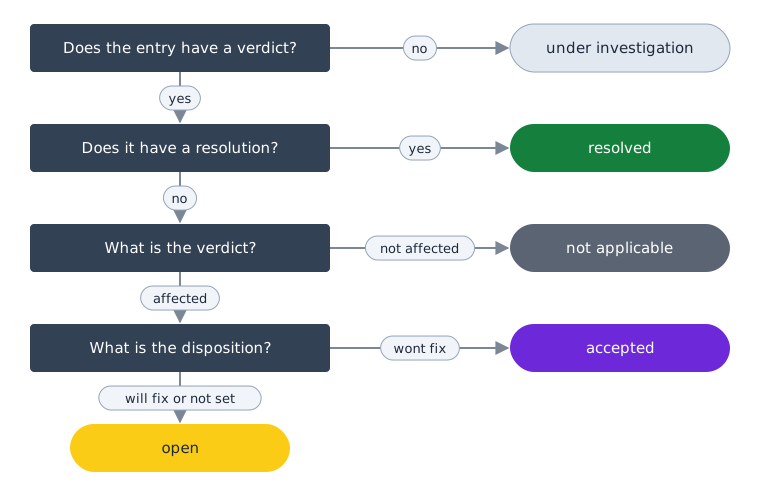
The Acme Shop example has an entry in each state.
The requests entry, CVE-2023-32681, has a report from Dependabot but no verdict yet.
Its state is under investigation.
Writing an analysis doesn’t change that.
Only a verdict ends the investigation.
Spring4Shell has the verdict affected and the disposition will fix, and no resolution.
Its state is open.
An affected entry without a disposition is also open, because nobody has decided to live with it.
The lodash entry, CVE-2021-23337, has the verdict affected and the disposition wont fix.
Its state is accepted.
The team accepted the risk because only administrators use the vulnerable function, and it gives them no access they don’t already have.
Text4Shell and the XZ Utils backdoor have the verdict not affected.
Their state is not applicable.
Log4Shell has the verdict affected and a resolution in 4.3.0.
Its state is resolved.
A resolution makes any entry with a verdict resolved, whether the verdict is affected or not affected.
A not affected entry with a resolution records that you updated the dependency anyway.
The complete set of rules is in States.
How accepted differs from not applicable
Both states mean you don’t plan any more work, but they say opposite things about risk.
not applicable is a claim about your software: the vulnerability can’t harm it.
accepted is a decision: the vulnerability can harm your software, and you chose not to fix it.
The report keeps them apart so that accepted risks don’t disappear among the many vulnerabilities that never mattered.
An accepted risk is worth reviewing from time to time.
If the circumstances change and the disposition becomes will fix, the entry is open again.
For lodash in Acme Shop, the analysis already says when the risk ends: the admin interface is removed in 5.0.
The state depends on the release you ask about
Without a release, the state describes your work on the entry.
Log4Shell is resolved because you recorded a resolution.
When you ask about a release with --as-of, the state describes that release instead.
Vulnlog considers the release you name and every release listed before it, and a resolution in a later release doesn’t count.
As of 4.2.0, Log4Shell is open, because its fix is in 4.3.0.
As of 4.3.0, it’s resolved.
A resolution recorded for 4.4.0, which isn’t published yet, counts as soon as you ask about 4.4.0.
So the state as of 4.4.0 shows what that release will fix before it ships.
State and suppression
The state alone doesn’t decide whether a scanner keeps reporting a vulnerability.
Spring4Shell is open but suppressed in Trivy until 2027-03-31, because its report has a suppress block with that date.
Vulnlog and your scanner explains which findings stay quiet, and why.
Because the state is a summary of what you recorded, a state that looks wrong always points back to the verdict, the disposition, or the resolution.
The entries that are under investigation or open show the work that remains, and the accepted entries show the risks to review.